Why Is My Couch Pilling — and How Do You Get the Fuzz Off?

Couch pilling is loose or short fibers that friction has rolled into small balls on the surface of the fabric. It is not dirt, it is not a hole in the weave, and — this is the part that catches almost everyone out — cleaning will not remove it. Pills have to be sheared off the surface. That is a separate job, usually called de-pilling or fabric shaving.
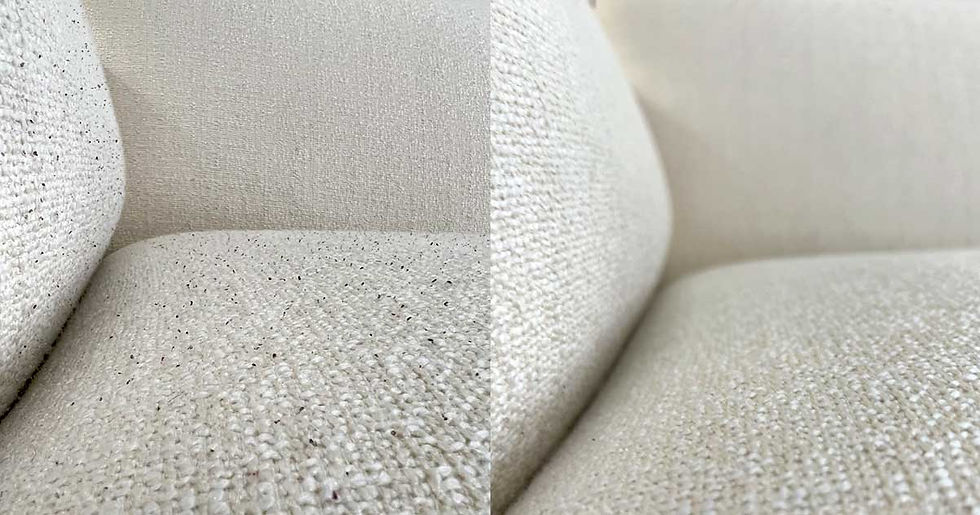
On a light-colored sofa, pilling is easy to mistake for filth. Pills trap dust, dark fibers, lint and pet hair, so what you actually see is gray or black speckling across the seat and along the arms. The sofa reads as dirty. People book a deep clean, the cleaning is
done properly — and the speckling is still there, because the problem was never soil.

We do this across New York City as an add-on to upholstery cleaning, and it comes up constantly — often on sofas that were cleaned somewhere else first and "did not come out." Here is what is actually going on, and what can and cannot be done about it.
What pilling actually is
Fabric is made of fibers of a certain length. Rubbing breaks some of them and works others loose, and those loose ends tangle into a tiny ball that stays attached to the surface by the longer fibers underneath. That ball is a pill. Enough of them and the fabric goes from smooth to fuzzy, and the surface starts catching every bit of lint in the room.
Every fabric can pill. Short-staple fibers and blends pill fastest — poly-cotton and poly-wool blends, chenille, microfiber, and the soft looped weaves like bouclé that have become so common. Long-staple and tightly twisted fabrics resist it longer, but nothing is immune, and a piece pilling does not mean it was cheap. Expensive fabric pills too; it usually just takes longer.
Why your couch is pilling
Usually it is a combination of these, not one cause:
Fiber and weave. Short fibers shed more, blends shed unevenly, and loose or looped weaves give loose fiber something to catch on. Our fabric-by-fabric guide covers which behave how.
Friction. Pills form where a body moves against fabric: the front edge of the seat, the top and outer sides of the arms, the back at head height.
New-fabric shedding. New upholstery sheds excess fiber for its first months. Some of it is vacuumed away and some of it rolls into pills. This phase passes.
What you put on it. Throws, blankets, sweaters, towels and pet beds all donate fiber to the surface — and dark fiber on light fabric is exactly what you end up looking at.
Pet hair and lint. Both work down into the weave and get bound into the pills, which is why vacuuming alone stops helping at a certain point.

Where pilling shows up first
Almost always the arms and the seat fronts, then the back at head height. If you are trying to work out whether you are looking at pilling or soiling, compare a high-contact area with somewhere nobody touches — the outside back panel, or the side facing the wall. Soil tends to be spread and blotchy. Pilling follows contact, and stops where contact stops.
Why cleaning does not remove pilling
This is the single most common misunderstanding we run into. Cleaning removes what is in the fabric: soil, body oils, odor, stains. Pilling sits on the fabric, mechanically anchored to it. Water, solvent, steam and extraction have nothing to grip — the pill is made of the same fiber as the sofa, and it is tied to the sofa.
There is a twist that makes it worse: a properly cleaned sofa often shows its pilling more clearly, because the general grayness that was hiding the texture is gone. The clean is real. The fuzz is still there. If you have ever paid for a cleaning and felt it barely changed anything, this is frequently why — and it is worth reading alongside our honest answer on what professional couch cleaning can and cannot do.
What de-pilling (fabric shaving) is
De-pilling is mechanical. A fabric shaver lifts the pills clear of the surface and cuts them off at the base, and the loosened fiber is then vacuumed away. There is no chemistry involved, nothing soaks in, and nothing needs to dry. The result is visible immediately — the fabric goes back to reading as its own color instead of a speckled version of it.
What it does not do, stated plainly:
It removes pills. It does not reverse wear. Thinning, fading and flattened pile are wear, and shaving does not bring them back.
Pilling can return. The friction that caused it continues after we leave. Pieces that are past their shedding phase come back much more slowly, but nothing makes a fabric permanently pill-proof.
Not every fabric is a straightforward candidate. Looped weaves like bouclé need care, because the loops are the design — a careless pass cuts them and that damage does not come back. It is doable, and we have done it on pieces like this three-section bouclé sofa on the Lower East Side, but it is judgement work, not a machine run flat across the surface.
It is a surface treatment, not a repair. A pulled thread, a snag or a split seam is upholstery repair, which is a different job.
Can you de-pill a couch yourself?
Yes, carefully, with a proper fabric shaver — not a razor and not a comb. The method matters more than the tool: work over a supported flat area so the fabric is not tented, keep the head flat against the surface, use light pressure, go in small sections, and empty the chamber often so it keeps cutting instead of dragging.
The risks are real, though, and they are not reversible. Too much pressure cuts into the fabric itself. Uneven passes leave shaved patches that show in raking light. And on a delicate or looped weave, the first mistake is also the last one. Test in a hidden area, and if you do not know what your fabric is, start by reading the tag properly — or accept that a piece you care about is not the place to practice.
How to slow pilling down
Vacuum with the upholstery tool weekly. Loose fiber that gets removed before it rolls never becomes a pill.
Rotate and flip cushions. It spreads friction instead of concentrating it in two spots.
Watch what you drape on it. New throws and fleece blankets shed heavily — wash them before they live on the sofa.
Stay on top of pet hair. Hair bound into pills is much harder to deal with than hair sitting on the surface.
Expect the first months to shed. On a new sofa this is normal and it settles.
How much does de-pilling cost in NYC?
At Cleaning LAB, de-pilling — fabric shaving — is an optional add-on service, not part of the base cleaning price. It is listed on our couch cleaning page as a fabric pilling (lint and fuzz) removal service, available on request.
It is quoted individually, because the work depends on how far the pilling has gone, how much surface is affected, and what the fabric will tolerate. An arm and a seat front is a different job from an entire sectional. There is a $150 minimum service charge per visit, and add-ons or additional pieces can be combined to reach it. For what drives upholstery pricing generally, see our couch cleaning cost guide for NYC.
The only accurate answer comes from photos. Send a close-up of the worst area in daylight and you will get an honest read — including when the honest read is that shaving will help less than you are hoping.
A note on results
Cleaning results vary depending on fabric type, material condition, and stain characteristics, and some stains or discolorations may be permanent and cannot be fully removed. That is why we evaluate the material and explain realistic expected results before cleaning begins. Professional cleaning improves cleanliness and appearance, but it does not restore damaged materials or reverse fabric wear, fading, or structural deterioration.
Couch pilling FAQ
Why is my couch pilling?
Because friction has broken and loosened short fibers on the surface and rolled them into small balls. It is caused by fiber type, weave and rubbing — not by dirt, and not necessarily by low quality. Blends, chenille, microfiber and looped weaves like bouclé pill fastest, and new upholstery sheds heavily for its first months.
Does professional cleaning remove pilling?
No. Cleaning removes what is in the fabric — soil, oils, odor and stains. Pilling sits on the surface and is anchored to the fabric, so no cleaning method detaches it. It has to be sheared off mechanically, which is a separate service called de-pilling or fabric shaving. A cleaned sofa often shows its pilling more clearly, because the soil that was masking the texture is gone.
Can pilling be removed permanently?
The existing pills can be removed completely. Pilling itself is not permanently cured, because the friction that creates it continues. Fabrics past their initial shedding phase pill back much more slowly, and regular vacuuming with an upholstery tool removes loose fiber before it has a chance to roll.
Is it safe to shave a bouclé or looped-weave sofa?
It can be done, but it is the fabric that needs the most judgement. The loops are the design, and a careless pass cuts them, which cannot be undone. It should be tested in a hidden area first and worked carefully by hand — this is not a fabric to run a shaver across at speed.
Does pilling mean my sofa is low quality?
Not necessarily. Pilling is about fiber length, twist and weave rather than price. Plenty of expensive fabrics pill, and some inexpensive tightly-woven synthetics barely do. What quality usually changes is how long it takes to start and how bad it gets.
Bottom line: if your sofa looks dirty but cleaning did not fix it, look closer — you are probably looking at pilling, and it needs shaving rather than washing. Send a daylight close-up of the worst area and you will get a straight answer about what can be removed. Here is our couch and upholstery cleaning in NYC, with de-pilling available as an add-on.


Comments